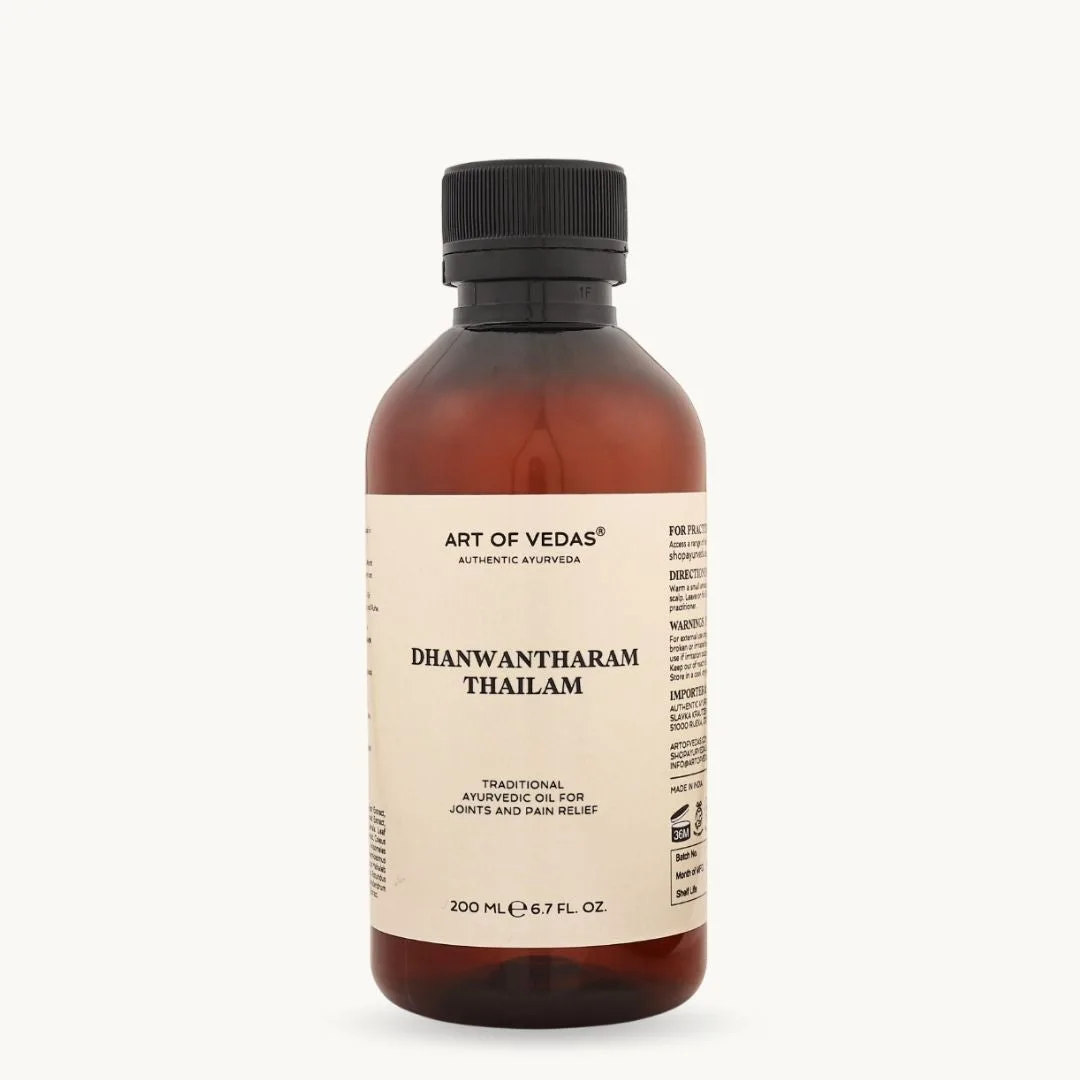
Dhanwantharam Kuzhambu et Dhanwantharam Thailam procèdent d'une seule et même filiation classique, et pourtant tout les sépare dans la main et sur la peau. L'un est une huile fluide; l'autre, une préparation semi-solide qui demeure exactement là où on la dépose. Trancher entre eux revient moins à désigner le meilleur qu'à reconnaître celui qui convient au moment, à la saison et à la routine que l'on entend tenir.
Cette comparaison met les deux formats en regard, afin que le choix aille de soi.
Deux formats, une même formule classique
Les deux préparations descendent de la même tradition: Bala, la plante stabilisante Sida cordifolia, entourée du groupe Dashamoola, les dix racines, et de plantes compagnes, conduites par les étapes classiques de la décoction Kashayam et de la pâte Kalka. C'est la finition qui les sépare. Le Dhanwantharam Thailam s'achève en huile liquide, qui se verse et qui glisse. Le Dhanwantharam Kuzhambu est travaillé plus avant avec des corps gras végétaux, jusqu'à une texture dense, semi-solide. Ce n'est jamais une huile, et il ne cherche nullement à s'y apparenter. Notre guide complet du Dhanwantharam Kuzhambu revient en détail sur ce format.
Texture, absorption, toucher
Le Thailam s'étale vite, couvre de grandes surfaces et appelle des gestes continus et amples. Le Kuzhambu, lui, réclame un autre tempo. Assoupli entre des paumes chaudes, il se pose sur la zone choisie, y adhère doucement et pénètre lentement, au fil d'un long repos. Là où le Thailam invite au mouvement, le Kuzhambu invite à l'immobilité. Le toucher suit la même logique: au Thailam un film fin et mobile, bientôt absorbé; au Kuzhambu une couche pleine et enveloppante, qui demeure jusqu'à ce qu'on la retire à l'eau chaude.
Ce que la tradition attend de chaque format
- Au Thailam l'Abhyanga du corps entier et les routines larges et fluides.
- Au Kuzhambu l'application locale et ciblée, sur le bas du dos, les genoux ou les épaules.
- Au Thailam les rythmes brefs du matin, avant le bain.
- Au Kuzhambu le long repos du soir, sans hâte, tout particulièrement durant les mois froids.
- Les foyers gardent traditionnellement les deux et prennent l'un ou l'autre selon ce que la journée demande.
Le verdict, saison, toucher et routine à l'appui
Dans la saison froide européenne, le Kuzhambu, plus riche et plus lent, mérite sa place dans les routines du soir, tandis que le Thailam reste, toute l'année, le compagnon naturel de l'Abhyanga régulier. Vous préférez un fini léger et une large couverture? Prenez le Thailam, et lisez notre article pratique sur comment utiliser le Dhanwantharam Thailam. Vous cherchez une attention concentrée sur une zone et un long repos tranquille? Prenez le Kuzhambu. Art of Vedas conserve les deux formats dans sa gamme, afin que la décision tienne à la routine et non à la disponibilité. Pour le contexte plus large de ce qui sépare ces deux catégories dans l'ensemble des formules kéralaises, notre panorama Thailam et Kuzhambu complète le tableau.
Questions fréquentes
La formule est-elle identique dans les deux formats?
Tous deux relèvent de la même tradition classique Dhanwantharam. Ce qui varie, c'est l'étape finale de préparation et la composition de la base, d'où le corps semi-solide du Kuzhambu et, avec lui, son caractère plus lent et plus localisé.
Le Kuzhambu convient-il au massage du corps entier?
La tradition ne l'emploie pas ainsi. Le Kuzhambu se réserve à l'application locale et ciblée, sur une zone choisie. Pour l'Abhyanga du corps entier, le Thailam fluide s'impose, et de loin, comme le choix le plus pratique.
Quel format pénètre le plus vite?
Le Thailam. Huile liquide, il s'étale en couche fine et se laisse absorber assez rapidement. Le Kuzhambu, lui, pénètre lentement par construction et demeure sur la zone d'application durant toute une longue pause.
Par lequel commencer?
La plupart débutent par le Thailam, d'un usage plus simple et plus familier. Le Kuzhambu récompense qui souhaite un rituel concentré sur une zone et accepte d'y consacrer le temps nécessaire.
Le Kuzhambu reste-t-il vraiment là où on l'applique?
Oui, et c'est là tout le principe du format. La préparation semi-solide se pose sur la zone choisie, le bas du dos ou un genou par exemple, et y libère son caractère pendant toute la durée du repos, au lieu de s'étaler en couche fine comme le ferait une huile fluide.
Faut-il les tiédir avant l'usage?
Tous deux se tiédissent traditionnellement en douceur, le Thailam jusqu'à une température agréable, le Kuzhambu jusqu'à l'assouplissement de sa texture. Un bol d'eau chaude répond aux deux besoins; la chaleur directe ne convient à aucun.
Cet article décrit une pratique ayurvédique traditionnelle et n'a qu'une valeur d'information générale. Il ne constitue ni un avis médical, ni un diagnostic, ni un traitement. Consultez un professionnel de santé qualifié avant d'entreprendre toute nouvelle routine, en particulier si vous êtes enceinte, si vous allaitez ou si vous suivez un traitement médical.